Chinese Official Mahjong · 24 pt
Full Flush in Chinese Official Mahjong (MCR): Points, Examples and Odds
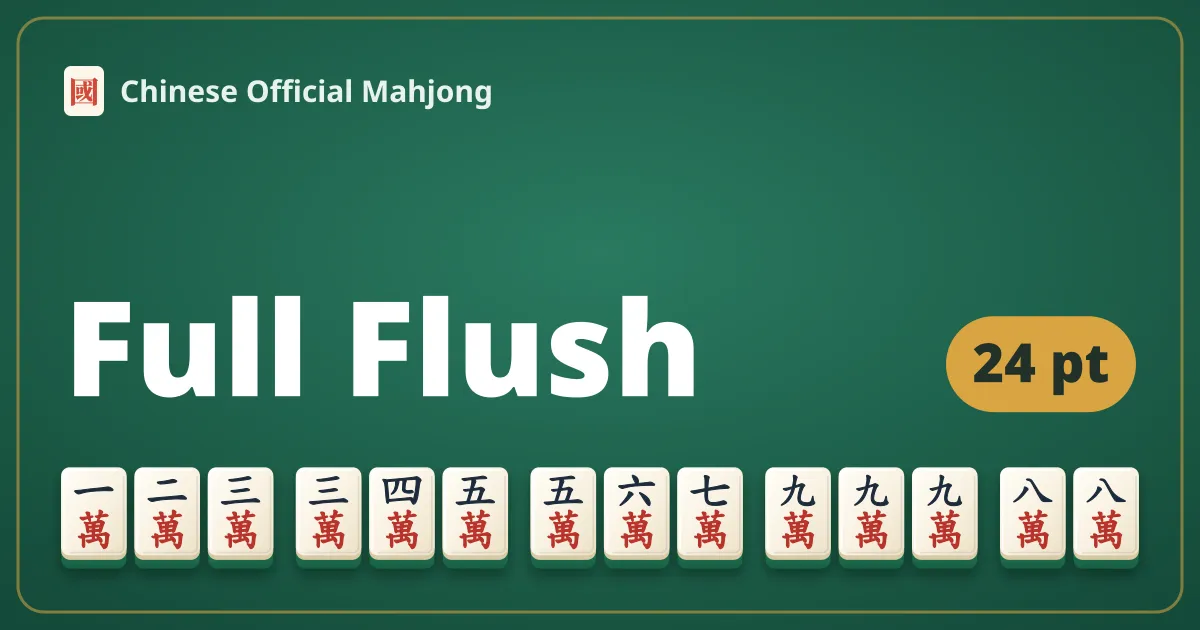
In Chinese Official Mahjong, Full Flush (清一色) is worth 24 points: when you win, the whole hand — the tiles in your hand and every claimed or kong set — is from one suit (characters, dots or bamboo), with no honor tiles at all. One Full Flush alone is far above the 8-point minimum.
On this page
The rules for Full Flush
- All 14 tiles are one suit: all characters, all dots or all bamboo
- No honors (winds or dragons); with honors it's Half Flush instead
- Chows, pungs and kongs are all allowed — the hand doesn't need to be concealed
- Flowers don't affect it; each scores 1 point separately (not toward the minimum)
What Full Flush no longer counts
Under the non-repeat rule, Full Flush already implies these, so they are not counted:
- No Honors (1 point): a Full Flush has no honors by definition
- One Voided Suit (1 point)
The other way round, a few bigger fan already include Full Flush, so with them Full Flush is not counted: Nine Gates, Seven Shifted Pairs (88 points each) and Pure Terminal Chows (64 points).
Full Flush vs Half Flush
| Fan | Suited tiles | Honors | Points |
|---|---|---|---|
| Full Flush | One suit only | None | 24 |
| Half Flush | One suit only | Some | 6 |
| All Honors | None | All | 64 |
How Full Flush waits
Tiles of one suit connect, so a ready hand often waits on many tiles at once. This hand wins on every character from 1 to 9 (it's the Nine Gates waiting shape):
The flip side: a player going for Full Flush discards almost nothing from that suit, so the others can read it from the discards and hold those tiles.
How Full Flush is scored
The points below are computed live by the same scoring code the game uses — including the fan that are not counted under the non-repeat rules.
Won on a discard
| Full Flush | 24 |
| Short Straight | 1 |
| Pung of Terminals or Honors | 1 |
| Total | 26 pt |
|---|
Reaches the 8-point minimum — a legal win.
Not counted (implied by a bigger fan): No Honors
Self-drawn
| Full Flush | 24 |
| Fully Concealed Hand | 4 |
| Short Straight | 1 |
| Pung of Terminals or Honors | 1 |
| Total | 30 pt |
|---|
Reaches the 8-point minimum — a legal win.
Not counted (implied by a bigger fan): No Honors、Self-Drawn
Won on a discard
| Full Flush | 24 |
| All Pungs | 6 |
| Pung of Terminals or Honors | 1 |
| Total | 31 pt |
|---|
Reaches the 8-point minimum — a legal win.
Not counted (implied by a bigger fan): No Honors
Common combinations:
| Combination | Points |
|---|---|
| Full Flush + All Pungs | 30 |
| Full Flush + Pure Straight | 40 |
| Full Flush + Pure Shifted Chows | 40 |
| Full Flush + Seven Pairs | 48 |
| Full Flush + Pure Triple Chow | 48 |
How it relates to other fan
- Half Flush: one suit plus honors, 6 points. If you're halfway to Full Flush but still hold an honor pair, switching to Half Flush is often faster.
- All Pungs: all four sets are pungs; stacks with Full Flush for 30 points.
- Pure Straight, Pure Shifted Chows, Pure Triple Chow: run patterns inside one suit show up naturally in a Full Flush and add on top.
- Seven Pairs: seven pairs all in one suit score Seven Pairs (24) plus Full Flush.
Full Flush odds
How many tiles of one suit you start with
Full Flush needs all 14 tiles from one suit, and each suit has only 36 tiles. In a 13-tile opening hand, the strongest suit has 8 or more tiles about 1.6% of the time, and 9 or more only 0.25%.
| Most tiles of one suit in the opening hand | Chance |
|---|---|
| 5+ tiles | 65% |
| 6+ tiles | 27% |
| 7+ tiles | 7.8% |
| 8+ tiles | 1.6% |
| 9+ tiles | 0.25% |
| 10+ tiles | 0.03% |
Source: 1,000,000 random 13-tile deals (flowers already replaced).
Normal play vs forcing Full Flush
The computers on this site plan their way to 8 points, and Full Flush is one of the routes they consider. In 4,000 hands of normal computer play, Full Flush appeared in 0.31% of wins, which averaged 30.2 points.
We also ran an experiment: in every hand, the player with the most tiles of one suit had to go for Full Flush — discard other suits and honors first, only claim that suit, never win with anything else — while the other three played normally. Then we compared it with the same opening hands where the computer decided for itself.
| Most tiles of one suit in the opening hand | Sample | Made it (forcing) | Someone else won | Avg. result forcing it | Made it (normal play) | Avg. result playing normally |
|---|---|---|---|---|---|---|
| 6 or fewer | 1,347 | 3.5% | 89% | −12.1 | 0.01% | −0.4 |
| 7 | 470 | 8.9% | 85% | −7.4 | 0.27% | +3.1 |
| 8 | 139 | 12% | 78% | −5.3 | 1.9% | +9.9 |
| 9 | 36 | 25% | 67% | +4.4 | 6.5% | +3.6 |
| 10+ tiles | 8 | 38% | 63% | +16.4 | 0% | +38.4 |
Source: computer play on this site. Forcing: 2,000 hands where the seat with the best start forced Full Flush while the other three played normally; normal play: 4,000 hands of four normal-level computers. Points use MCR scoring (self-draw: each pays fan + 8; discard: the discarder pays fan + 8, the others 8 each).
MCR games are slow (everyone needs 8 points), so forcing Full Flush works better than you might expect — but only when you start with a very concentrated hand.
- With 9 or more tiles of one suit, forcing it works about 27% of the time; finished hands averaged 34.4 points after 14.9 draws.
- With 8 or more, forcing it averaged −2.4; the same starts left to the computer's own judgement averaged +9.4. Forcing it without enough suited tiles gives the others too much time to win first.
- Playing normally, the computers rarely go for Full Flush: of the players who started with 8+ tiles of one suit, only 2.5% ended with a Full Flush — they prefer faster 8-point routes like Half Flush, Pure Straight or Seven Pairs.
Which hands suit Full Flush
- Lots of one suit in the opening hand: by far the most important factor — see the numbers above.
- Tiles that connect: with the same count, adjacent pairs of tiles beat scattered ones, because they let you chow.
- Claiming is allowed: Full Flush doesn't need a concealed hand, so chow that suit from the player on your left and save several turns.
- Others will defend: two exposed sets of one suit and none of it in your discards tell everyone what you're doing.
When to give up: less than half the wall is left and you still hold three or more tiles from other suits, or someone is clearly ready while you're far away. Switch to Half Flush, or look for another 8-point route. To try it yourself, open a table of Chinese Official Mahjong online — the computers play with you and the scoring is done for you.
Full Flush in other mahjong styles
Full Flush is a big hand everywhere, but scores differently:
- Taiwanese mahjong: 8 tai (Taiwanese mahjong Pure One Suit)
- Japanese mahjong ("Chinitsu"): 6 han concealed, 5 han open (Japanese mahjong Chinitsu)
- Hong Kong mahjong: 7 fan (Hong Kong mahjong Pure One Suit)
- Sichuan mahjong: 2 fan (Sichuan mahjong Pure One Suit)
FAQ
How many points is Full Flush?
In Chinese Official Mahjong Full Flush is worth 24 points — enough on its own to clear the 8-point minimum. No Honors and One Voided Suit are not counted with it.
Can Full Flush have honor tiles?
No. With honors it's Half Flush, 6 points; a hand of only honors is All Honors, 64 points.
Can you chow or pung in Full Flush?
Yes. MCR Full Flush doesn't require a concealed hand; claimed sets just have to be the same suit.
How many points is Full Flush with All Pungs?
Full Flush 24 plus All Pungs 6, 30 points in total — more with concealed pungs or terminal pungs.
Does Nine Gates still count Full Flush?
No. Nine Gates (88 points) already includes Full Flush, so under the non-repeat rule it is not counted again.
Related fan
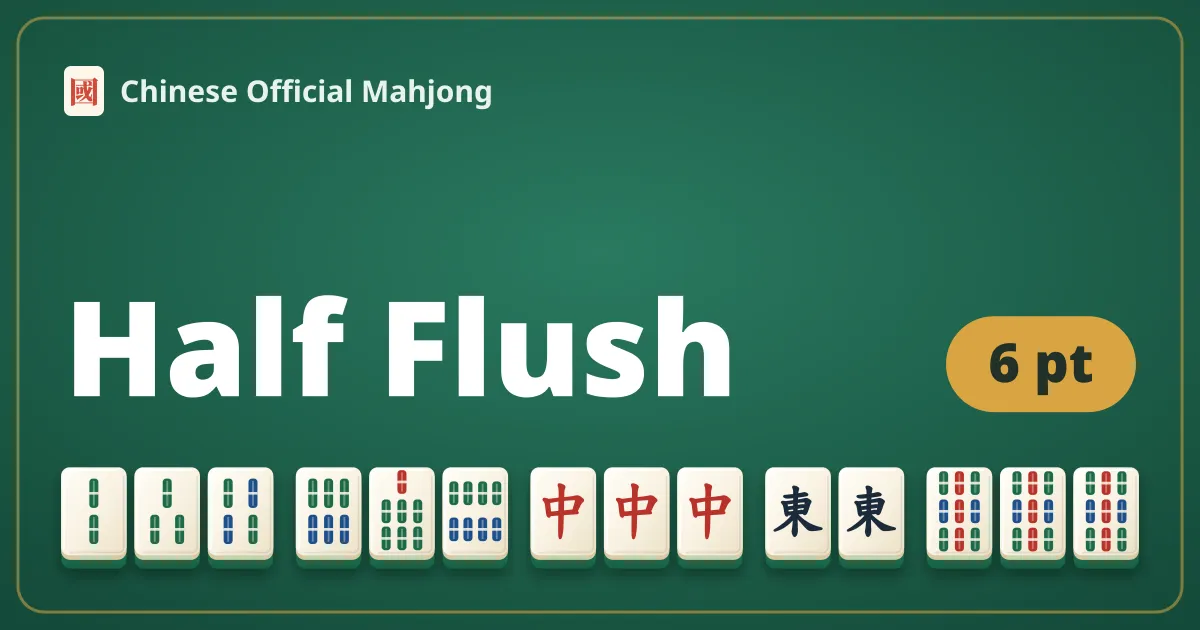 Half Flush 6 pt
One suit plus honors for 6 points — short of the 8-point minimum. How to top it up with dragon and wind pungs, and when to go for it.
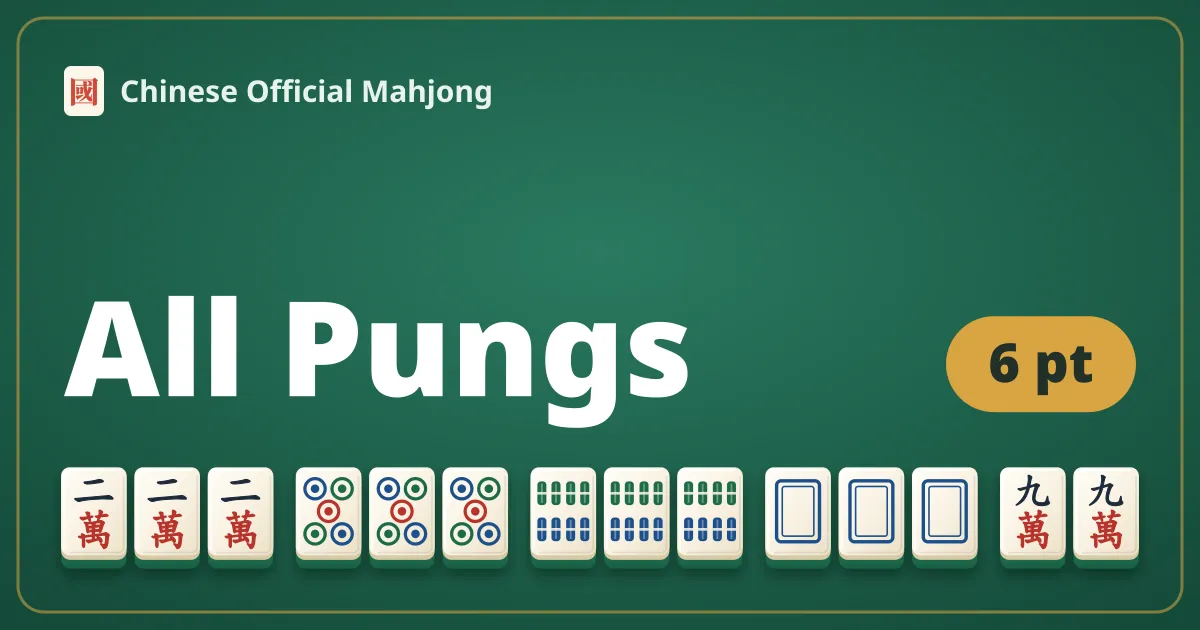 All Pungs 6 pt
Four pungs and a pair for 6 points — short of the 8-point minimum. How to top it up and what it stacks with.
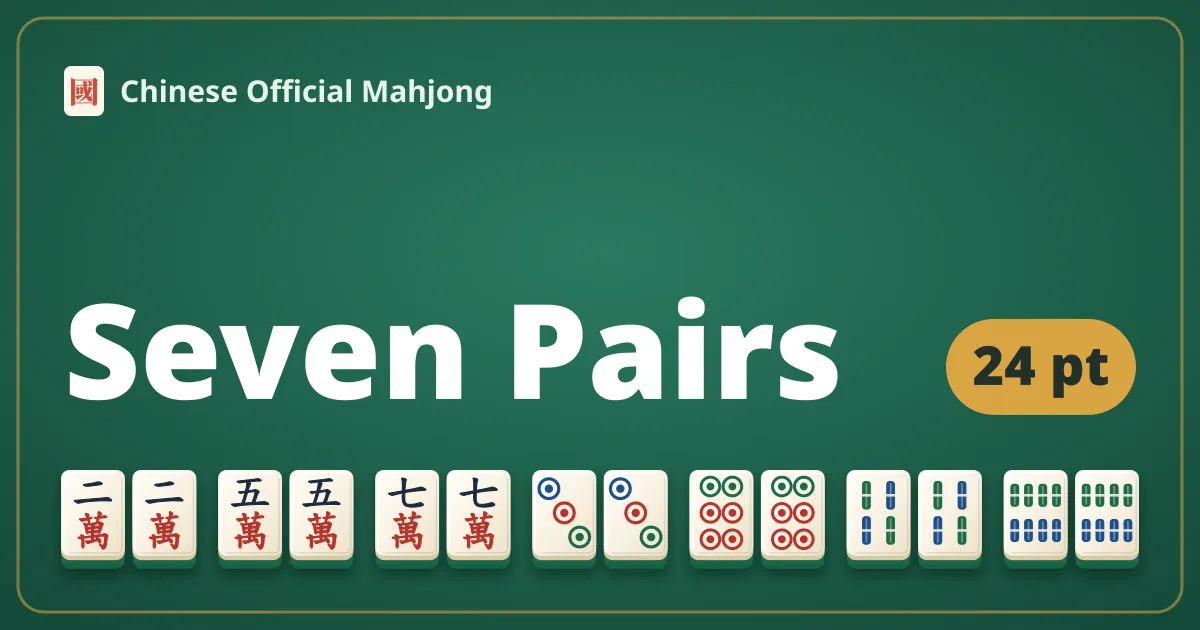 Seven Pairs 24 pt
Seven pairs for 24 points: four of a kind as two pairs, what it doesn't combine with, the wait, and how many opening pairs make it worth chasing.
Try it at the table
Chinese Official Mahjong — Play Chinese Official Mahjong (Mahjong Competition Rules, MCR) free in your browser against three computer opponents. 8-point minimum, all 81 fan scored automatically with the official non-repeat rules. No sign-up, works on phone and desktop.